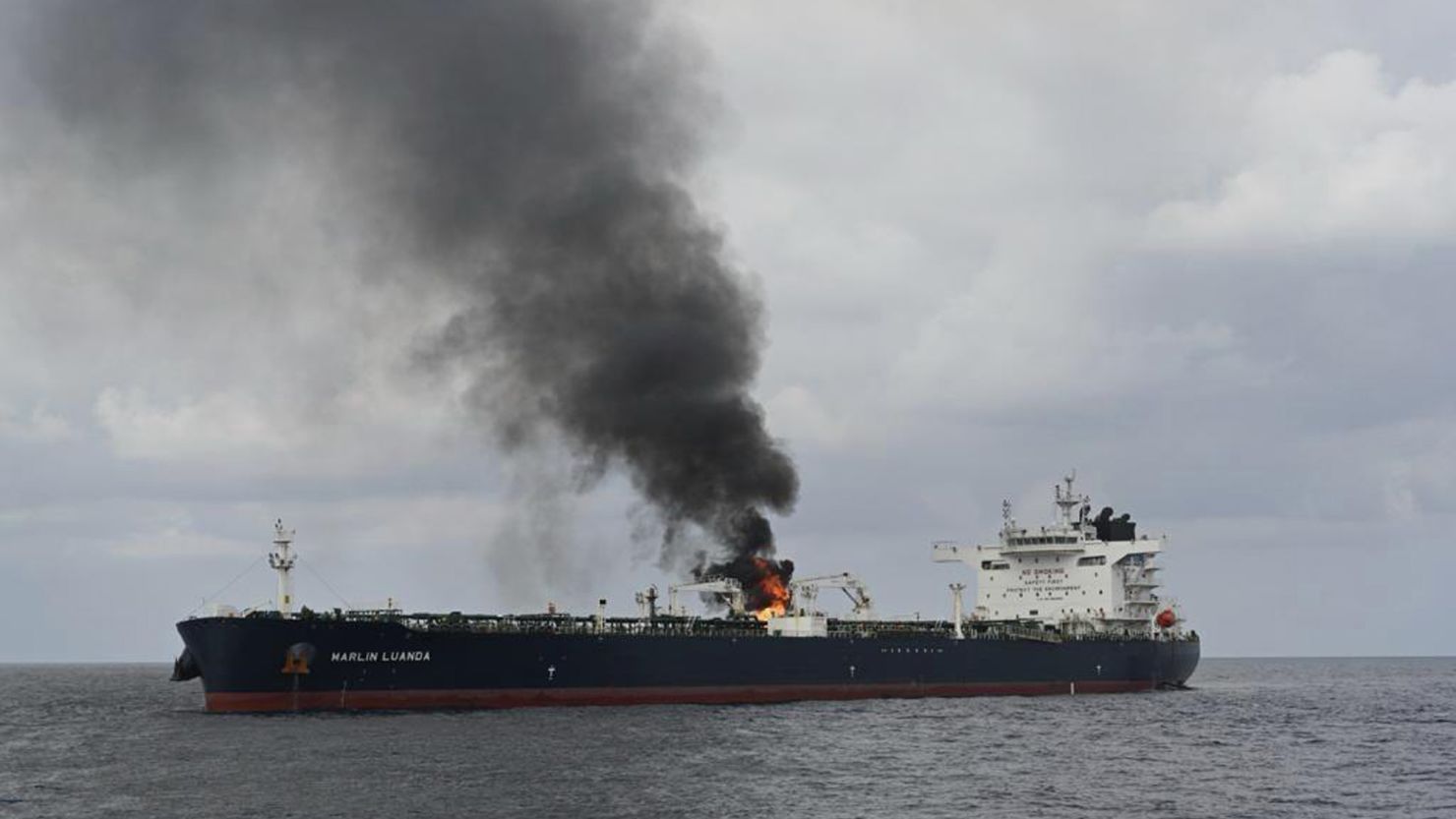
(Photo: CNN)
1. A Snapshop of the Red Sea Crisis
The crisis in the Red Sea in 2023-2025 presents multiple layers of maritime threats.
The first threat is the use of force on vessels. Following the outbreak of the Israel - Hamas conflict, in October 2023, the Houthi movement in Yemen declared their intention of attacking vessels associated with Israel in the Red Sea
2. On 14 November 2023, the Houthis announced their plans to strike such ships, and by December, this force had expanded its threat by vowing to block all Israel-bound maritime traffic
3. Also in November, Houthi forces “hijacked” the M/V Galaxy Leader using Mil Mi-17 helicopter and small boats, taking full control of the vessel and all 25 crew members were taken hostage
4. Attacks went on and it has been estimated that, from November 2023 to May 2025, around more than 300 attacks were launched by the Houthis against commercial vessels in the Red Sea and Gulf of Aden.
5 These assaults have damaged ships, injured crew members, and forced shipping companies to reroute, significantly increasing costs and delivery times
6. One serious case was the attack on the M/V Rubymar on 18 February 2024, which sank two weeks later
7. Legal observers have debated about whether Houthi’s attacks constitute “piracy” under the 1982 United Nations Convention on the Law of the Sea (hereby UNCLOS)
8, but regardless of its legal nature, it is undeniable that such use of force poses a threat to vessels, especially commercial ones.
Second, the Red Sea’s crisis is further complicated by increasing militarization. In response to Houthi’s attacks, the U.S. and the U.K. led multiple military efforts targeting Houthi elements in Yemens, such as Operation Poseidon Archer
9 in January 2024 (with the support from Australia, Bahrain, Canada, Denmark, Netherlands, and New Zealand), and Operation Rough Riders
10 in March 2025 (with an even greater scale)
11. Israel also carried out multiple rounds of attacks on the Houthi-controlled parts of Yemen. In turn, the Houthis promised retaliation, with military support from Iran
12. It has been argued that Iran has utilized the crisis to expand its influence militarily, charting new weapon smuggling routes.
13 Moreover, surrounding countries also contribute to this militarization trend, with Djibouti’s bolstering military patrols in the Red Sea
14, Saudi Arabia’s and the UAE’s boosting military spending and strengthening ties with Western partners to counter the Houthis, and more frequent joint exercises
15, etc. Whether or not such military measures were effective is still up to debate
16, but militarization can raise the risk of miscalculation and confrontation, further disturbing the overall security situation in the Red Sea.
Third, the Red Sea’s crisis displays the threat from hybrid or gray-zone warfare. About the actors, the Houthis do not represent a state, even though they are linked to state actors such as Yemen and Iran, hence their operating under the threshold of a traditional interstate armed conflict
17. About the tool, on the ground, the Houthis have utilized UAVs against highly equipped naval forces.
18 Additionally, the Houthis are gaining not only battlefield capacity but also a degree of political legitimacy, partly thanks to its usage of media/informational campaign to rally international support
19. About targets, apart from vessels, multiple maritime infrastructure have been affected by the crisis, including ports, undersea cables and offshore energy installations, etc.
20 Some of the cases are difficult to be verified as intentional, such as the cable disruption on February 24, 2024.
21 The attack’s aftermath can also spill into other layers of maritime space. For instance, the attack on the Rubymar, which was carrying oil and fertilizer, raised serious environmental concerns.
22
The Red Sea’s crisis, despite its outbreak in 2023, has deeper causes, two of which will be discussed by this essay. First, it is the inherent instability in the Middle East, stemming from historical problems. The most notable one is the Israel-Palestine conflict, which led to the Gaza war between Israel and Hamas in 2023, creating the justification for Houthis’ attacks: to put pressure on Israel and show solidarity with Palestine.
23 The Israel–Iran conflict is also a part of the equation. These two have been in proxy wars since the 1980s, and had many indirect confrontations in the Red Sea, partly encouraging Iran’s backing of the Houthis
.24 Other than that, since the Red Sea is bordered by many countries (Yemen, Saudi Arabia, Egypt, Sudan, Eritrea, and Djibouti), it has been argued that each country’s security problems can bring extra fragility to the Red Sea’s security, exacerbating the Red Sea crisis. For example, Iran and Saudi Arabia's longstanding rivalry, reflected in their support for opposing factions in Yemen, has fueled the Houthis’ capacity to target commercial vessels
25. By backing the Houthis, Iran gains strategic depth along the Bab el-Mandeb Strait, directly threatening Saudi-aligned maritime routes. In turn, Saudi Arabia has responded with its military interventions in Yemen since 2015, deploying naval patrols and enforcing blockades from the Red Sea.
26 Armed violence in Sudan is also a destabilizing factor, as the collapse of security in Port Sudan has created opportunities for arms trafficking and other illicit activities
27.
The second factor worth highlighting is the big powers’ influence. Big powers have been supporting opposing sides, subsequently prolonging the crisis. While the U.S. and the U.K. led the operations against Houthis in Yemen, China was reportedly providing equipment and intelligence to the Houthis via Iran
28, and Russia was allegedly sending technical assistance and smuggling arms to the Houthis
29. China also voiced its disapproval of U.S. actions, with its state-owned media outlet framing the crisis as a sign of “U.S.’ impotence” and asserting that U.S. military intervention has “only triggered more resistance”
30.
Moreover, big powers contribute to the Gaza crisis and overall regional instability, which are linked to the Red Sea crisis. For instance, divisive political trends have rendered the UN in putting forward resolutions regarding the Israel-Palestine dispute or the Gaza crisis. U.S. support for Israeli has also been argued as a disregard of international humanitarian law, further motivating Israel to continue its operation in Gaza, subsequently frustrating the Houthis
31.
2. Implications for the Indo-Pacific
The 2023-2025 Red Sea crisis, along with its deeper crisis in Gaza and other drivers mentioned above, bears certain implications to the Indo-Pacific. Those implications, which can be both direct and indirect, are seen in three main domains.
On the strategic – political domain, the Red Sea crisis can divert strategic attention away from the Indo-Pacific. For the U.S., its resources are not unlimited, especially in terms of military term
32. If the Red Sea situation continues, the U.S. might need to send extra munitions and troops to the Middle East, subsequently increasing cost on its already stretched defence posture
33, absorbing potential resources for the Indo-Pacific.
These are not just rhetoric as similar scenarios have happened. With the Ukraine crisis, the U.S. increased its troops in EUROCOM by 25,000 after the Ukraine war broke out in 2022, and that trend continued in 2023 and 2024. In contrast, during the same period, U.S. troops in the Indo- Pacific remained relatively the same, despite the Indo-Pacific being considered the most important theatre in its National Security Strategy
34. Regarding military assistance, in 2024, U.S. Foreign Military Funds for the Indo-Pacific capped at around $2 billion, significantly less than $4 billion committed to Israel alone. U.S. officials themselves have admitted this effect, as INDOPACOM Head Adm. Samuel Paparo warned in 2024 that the U.S providing air defences to both Ukraine and Israel was impeding INDOPACOM’s posture
35.
This possibility is even more likely in the current context. On academic platforms, some voices have already called for the U.S. to slow down the Indo-Pacific deployment to re-invest in the Middle East because of the Red Sea crisis
36. With the new Trump’s administration, Trump’s tough stance against terrorism and preference for unilateral acts have led to concerns about the U.S. being lured into an endless war with the Houthis, thus reaching its own “political and industrial limits”
37.
When U.S. strategic attention is diverted from the Indo-Pacific to the Red Sea, the balance of power in the Indo-Pacific is also potentially disrupted. Many have opined that China will take advantage of the strategic gap the U.S. has left to increase its regional outreach, even going further by turning the Red Sea into a “trap” for the U.S.
38. And China itself is not reluctant to demonstrate its desire. An article on Xinhua News describes U.S. struggle in the Red Sea only invites more resistance, reflecting the U.S. weakness against non-traditional threats (the Houthis) and deterioration of its economic influence and alliances
39. Moreover, the Red Sea crisis can also strengthen China-Russia-Iran cooperation
40, potentially creating a new polar in a global scale that could disrupt the long-standing post-war liberal international order, which is observed in the Indo- Pacific. Such a power play is, indeed, not ideal for countries who desire a stable extra-regional environment to balance or hedge against regional big powers’ rivalry like Vietnam.
Another point is,
the Red Sea gray-zone or hybrid warfare tactics could be replicated in the Indo- Pacific. The Houthis’ operations in the Red Sea share some similarities to China’s maritime militia in the South China Sea. Both are state-supported groups conducting aggression in maritime chokepoints, using informational campaigns to spread narratives justifying their acts
41. Because of such similarities, as well as China’s reported support of the Houthis mentioned above, it can be assumed that China might view the Red Sea and the South China Sea in tandem, applying lessons learned from Houthis’ gray zone deployment in the Red Sea to the Indo-Pacific.
Regarding international law and governance, the Red Sea crisis can weaken the rule of law in general, indirectly diminishing the rules-based order in the Indo-Pacific that many countries want to promote. Such causational dynamics can be seen via three ways.
First, the Red Sea crisis shows that international maritime law is not perfect. The Houthis is a non- state actor, despite being heavily armed, so theoretically it is not a subject of UNCLOS. Even when there has been evidence that link Iran to Houthis’ acts, Iran has been using the Houthis card flexibility and skilfully to maintain its deniability of substantial accountability (related to criminal activity)
42. Moreover, whether actions carried out by Houthis can be considered an offence in UNCLOS or not is subject to debate. UNCLOS’ definition of “piracy” only applies on actions for private ends on the high seas. The 1988 Convention for the Suppression of Unlawful Acts against the Safety of Maritime Navigation (SUA Convention) can be evoked alternatively, but limits exist as Yemen has not become a party to the 2005 Protocol amending SUA Convention
43, and SUA Convention does not justify enforcement measure
44. The usage of drones or UAV, and gray zone tactic are not addressed by international law as well.
Second, the Red Sea crisis demonstrates that big powers have trouble coordinating, raising doubt towards global governance duties assumed by big powers and global institutions, making way for further unilateral and adventurous actions. As mentioned above, foreign actors interfere in the crisis in multiple directions, supporting different factions because of diverse interests. At the United Nations, a resolution has been passed at the Security Council to condemn Houthis attacks
45, but solutions on deeper causes, such as the Gaza conflict prove to be harder to reach due
46. This reality not only complicates the situation on the ground but also hints at the incapability of the overall international system to handle crises in general.
Third, the Red Sea crisis can be used to highlight the “double standard” or “cherry picking” of big powers when it comes to international law. Some countries, such as China, have already utilized the fact that the U.S. is not a party to UNCLOS to refute U.S.’ protest against their maritime claims
47. Moreover, the U.S. has been criticized for its selectivity in applying international law regarding crises in the Middle East – a cause for the Red Sea crisis, which could undermine legal objectivity
48. If continued, this could create precedents for others to interpret international law not in good faith or invite further double standards in the Indo-Pacific, especially in maritime disputes like the South China Sea or the East China Sea. The precedent will be severe for small and middle countries who usually rely on international law to protect their interests in maritime disputes
49.
On the economic domain, supply chain disruption in the Red Sea brings consequences to global shipping, affecting Indo-Pacific countries. As mentioned above, the crisis lead to significant rerouting of traffic
50, not only reducing maritime activities in the Gulf of Aden and Suez Canal
51, but also increasing transportation – insurance cost for trade, hindering production and disrupting the overall supply chain. Take Vietnam for example. Because of the conflict, Vietnam’s export to Europe avoided the Suez Canal and went around the Cape of Good Hope instead, making its travel increase by 10-15 days
52. Vietnam Maritime Administration also reported that freight rates from Vietnam to the East Coast area in the U.S. increased greatly, from U.S.$2,600/container in December 2023 to U.S.$4,500 in January 2024 (around 70% increase)
53. Freight rates to the Vietnam’s European markets, including Germany, also increased by nearly three times from December 2023 to January 2024
54. Additionally, the crisis might make some Indo-Pacific countries’ export industries become less attractive compared to their competitors. For instance, following the Red Sea crisis, small Indian exporters reportedly witnessed their products’ competitive advantage significantly reduced as shipping costs soared, largely owing to the country being more distanced to targeted markets than Turkish and Polish competitors
55.
However,
there are positive implications for the Indo-Pacific that can arise from the Red Sea crisis. First, the crisis creates hardships that incentivize relevant industries, ranging from shipping to telecommunication, to quickly adapt with the situation. Countries along the Asia-Africa-Europe economic corridor might relocate their production to evade transportation costs in ways that benefit the Indo-Pacific. For example, the Federation of Malaysian Manufacturers (FMM) has urged Malaysia’s private manufacturers to re-orient their businesses to nearby ASEAN countriesto mitigate disruptions caused by the Red Sea crisis
56. In other words, whether or not the Red Sea crisis will be managed in the short-or-medium term, some economies might become more resilient if they successfully adapt to, and be well-prepared with, future challenges.
Secondly, the rerouting of ships via the Cape of Good Hope also opens up opportunities to strengthen the connection between the Indo-Pacific and African regions as countries along this alternative maritime route will be motivated to improve relevant infrastructures (ports, logistics, etc.).
57 Additionally, this might encourage the two regions to address existing inter-regional economic shortcomings. Particularly for ASEAN, a comprehensive engagement with African countries will likely yield significant improvements in ASEAN-Africa economic ties compared to the current fragmented engagement between just a few large nations
58. New dynamics following the enhancement of Asia-Africa economic linkage might also breathe new life into existing mechanisms, such as the Asia-Africa Growth Corridor (AAGC) launched in 2017 by India and Japan but has lost its initial momentum
59.
In conclusion, the Red Sea’s maritime security situation can be characterized with the Red Sea crisis, which presents multiple maritime threats, including the use of force on vessels, increasing militarization and usage of hybrid or gray-zone warfare. The crisis stems from numerous causes, among which are the inherent instability originating from historical issues in the Middle East, most notably the Israel - Palestine issue, and big powers’ intervention for their own interests. The crisis can lead to multiple implications to the Indo-Pacific. Strategically, the strategic attention and resources could be divered away from the Indo-Pacific, affecting the balance of power there. The Red Sea crisis can also create precedents for further gray-zone tactics to be used in the Indo- Pacific. Legally, the crisis can weaken the overall rule of law that many Indo-Pacific countries champion. Economically, despite several potential opportunities for reforms and new connections, supply chain disruption and trade losses caused by the crisis have also been felt in certain Indo- Pacific countries.
Do Manh Hoang
Le Ngoc Mai
Nguyen Khanh Nam
South China Sea Institute, Diplomatic Academy of Vietnam
The views expressed in this article are solely of the author
6. 'Iran's Support of the Houthis: What to Know', Council on Foreign Relations (Web Page, 24 March 2025) https://www.cfr.org/in-brief/irans-support-houthis-what-know.
8. United Nations Convention on the Law of the Sea, opened for signature 10 December 1982, 1833 UNTS 397 (entered into force 16 November 1994) art 101
9. Wolf-Christian Paes, Edward Beales, Fabian Hinz, and Albert Vidal, Navigating Troubled Waters: The Houthis’ Campaign in the Red Sea and the Gulf of Aden (Research Paper, International Institute for Strategic Studies, December 2024) https://www.iiss.org/globalassets/media-library---content--migration/files/research- papers/2024/12/navigating-troubled-waters.pdf.
10. Wolf-Christian Paes, Edward Beales, Fabian Hinz, and Albert Vidal, Navigating Troubled Waters: The Houthis’ Campaign in the Red Sea and the Gulf of Aden (Research Paper, International Institute for Strategic Studies, December 2024) https://www.iiss.org/globalassets/media-library---content--migration/files/research- papers/2024/12/navigating-troubled-waters.pdf
15. Febrina Estika, Hikmat Zakky Almubaroq and Ari Pitoyo Sumarno, 'Red Sea War: How the Houthi Onslaught Affected the Security of the State' (2024) 3(12) East Asian Journal of Multidisciplinary Research 5861-5870, 5867.
16. Maysaa Shujaa Aldeen, 'The Paradox of Intervention: How US Strikes in Yemen Empowered the Houthis', European Council on Foreign Relations, (Web Page, 13 May 2025) https://ecfr.eu/article/the-paradox-of- intervention-how-us-strikes-in-yemen-empowered-the-houthis/
17. William C. Wohlforth, 'International Competition Below the Threshold of War: Toward a Theory of Gray Zone Conflict' (2020) 44 Security Studies 2.
19. Thomas Lim and Eric Ang, 'Comparing Gray-Zone Tactics in the Red Sea and the South China Sea' The Diplomat, (Web Page, 20 April 2024) https://thediplomat.com/2024/04/comparing-gray-zone-tactics-in-the-red-sea- and-the-south-china-sea/.
20 'The Houthis and the Red Sea: A New Risk to Subsea Cables', Data Center Dynamics (Web Page, 2024) https://www.datacenterdynamics.com/en/analysis/the-houthis-and-the-red-sea-a-new-risk-to-sub
21. Sean Monaghan, Michael Darrah, Eskil Jakobsen, and Otto Svendsen, 'Red Sea Cable Damage Reveals Soft Underbelly of Global Economy', Center for Strategic and International Studies (Web Page, 7 March 2024) https://www.csis.org/analysis/red-sea-cable-damage-reveals-soft-underbelly-global-economy.
22. 'Sinking of Rubymar in Red Sea Poses Grave Environmental Risks, Experts Warn', The Guardian (Web Page, 5 March 2024) https://www.theguardian.com/world/2024/mar/05/sinking-of-rubymar-in-red-sea-poses-grave- environmental-risks-experts-warn.
23. 'Calming the Red Sea’s Turbulent Waters', International Crisis Group (Web Page, 2 April 2025) https://www.crisisgroup.org/middle-east-north-africa/gulf-and-arabian-peninsula/yemen/248-calming-red-seas- turbulent-waters
25. Taneja, Kabir, 'The Red Sea Crisis and Political Equity of Non-State Armed Actors', Observer Research Foundation (Web Page, 2 February 2024) https://www.orfonline.org/expert-speak/the-red-sea-crisis-and-political- equity-of-non-state-armed-actors/
27. Lons, Camille, ‘Anatomy of a Chokepoint: Mapping Power and Conflict in the Red Sea’, European Council on Foreign Relations (Web Page, 9 May 2025) https://ecfr.eu/special/anatomy-of-a-chokepoint-mapping-power-and- conflict-in-the-red-sea/.
28. Abo Alasrar, Fatima, ‘How China Turned the Red Sea into a Strategic Trap for the US’, Atlantic Council (Web Page, 5 May 2025) https://www.atlanticcouncil.org/blogs/menasource/how-china-turned-the-red-sea-into-a- strategic-trap-for-the-us/.
29. Abo Alasrar, Fatima, 'The United States’ Houthi Terrorist Designation Unmasks Russia’s Yemen Strategy', Atlantic Council (Web Page, 3 March 2025) https://www.atlanticcouncil.org/blogs/menasource/houthi-terrorist- designation-russias-yemen-strategy/.
30. 'Unipolar Hegemony Struggles to Resolve the Red Sea Shipping Crisis',Xinhua News Agency (Web Page, 14 April 2025) http://www.news.cn/globe/20250414/b5cabe2fd0ff4a6fb971c999cf7c3e16/c.html.
31. Denton-Townshend, Dr. Estelle, 'Assessing the Impact of the Red Sea Crisis on the Rules-Based International Order: Implications for the Indo-Pacific', Divergent Options, (Web Page, 22 April 2024) https://divergentoptions.org/2024/04/22/assessing-the-impact-of-the-red-sea-crisis-on-the-rules-based-international- order-implications-for-the-indo-pacific/
33. Ibid.
35. Copp, Tara, 'US arms stockpiles strained by Ukraine, Israel support: INDOPACOM boss', Defense News (Web Page, 21 November 2024) https://www.defensenews.com/global/the-americas/2024/11/21/us-arms-stockpiles- strained-by-ukraine-israel-support-indopacom-boss/.
37. McLeary, Paul, and Jack Detsch, 'US strikes on Houthis stoke risk of wider, longer conflict', Politico (Web Page, 18 March 2025) https://www.politico.com/news/2025/03/18/us-houthi-endless-war-risk-00236679.
38. Abo Alasrar, Fatima, 'How China Turned the Red Sea into a Strategic Trap for the US', Atlantic Council (Web Page, 5 May 2025) https://www.atlanticcouncil.org/blogs/menasource/how-china-turned-the-red-sea-into-a- strategic-trap-for-the-us/
39. 'Unipolar Hegemony Struggles to Resolve the Red Sea Shipping Crisis', Xinhua News Agency, (Web Page, 14 April 2025) http://www.news.cn/globe/20250414/b5cabe2fd0ff4a6fb971c999cf7c3e16/c.html.
40. Abo Alasrar, Fatima, 'How China Turned the Red Sea into a Strategic Trap for the US', Atlantic Council (Web Page, 5 May 2025) https://www.atlanticcouncil.org/blogs/menasource/how-china-turned-the-red-sea-into-a- strategic-trap-for-the-us/
41. Lim, Thomas, and Eric Ang, 'Comparing Gray-Zone Tactics in the Red Sea and the South China Sea', The Diplomat (Web Page, 20 April 2024) https://thediplomat.com/2024/04/comparing-gray-zone-tactics-in-the-red-sea- and-the-south-china-sea/
45. 'UN Security Council Adopts Resolution on Red Sea Shipping Security' UN News (Web Page, 30 January 2024) https://news.un.org/en/story/2024/01/1145382.
47. John Norton Moore, The Struggle for Law in the Oceans: How an Isolationist Narrative Betrays America (Oxford University Press, 2023).
48. Vermeer, Zachary, 'The Jus ad Bellum and the Airstrikes in Yemen: Double Standards for Decamping Presidents?’ EJIL:Talk! (Web Page) https://www.ejiltalk.org/the-jus-ad-bellum-and-the-airstrikes-in-yemen-double- standards-for-decamping-presidents/.
49. Adam Lupel and Lauri Mälksoo. “Small States’ Commitment to International Law.” (2019) A Necessary Voice: Small States, International Law, and the UN Security Council, International Peace Institute, 3.
http://www.jstor.org/stable/resrep19645.5.
51. Rodriguez-Diaz, Alcaide, and Garcia-Llave, 'Challenges and Security Risks in the Red Sea: Impact of Houthi Attacks on Maritime Traffic' (2024) Journal of Marine Science and Engineering https://www.mdpi.com/2077- 1312/12/11/1900